Herp Friday: Broadhead Skink, Eumeces laticeps


This broadhead skink, Eumeces laticeps, has been seen hanging around my house several times in the last few weeks. I was able to get some extreme close-ups of it one day when it was cool outside and he was a little sluggish. I had a fairly easy time identifying it simply based on its appearance, but to be certain, I used the key to the lizards of Arkansas contained in the excellent book, The Amphibians and Reptiles of Arkansas by Stanley Trauth et al
 . Here are the basic steps I went through (not numbered here as in the key but as the number of steps I took):
1. Four legs present.
2. Body scales smooth, shiny and overlapping. (That places them in the family Scincidae).
3. Frontal scale rectangle shaped; supranasal scales present (see below); lower eyelid without transparent disk. (not pictured)
4. Dorsal and lateral scales in parallel rows with the long axis of the body (2nd picture above).
5. Chin with 2 postmental scales. (not pictured)
6. Eight or nine upper labials; no postlabial or if present one or two small postlabials, the sixth labial is the first to contact the orbit (see below); maximum SVL over 85 mm (didn't measure)........Broadhead skink, Eumeces laticeps
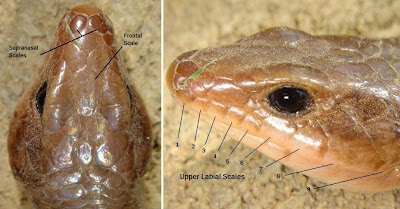
These are relatively large lizard for this area. The adults are usually tan or brown except for the head which may turn red or orange in males during breeding season. This lizard's home range is essentially the southeastern quarter of the U.S., which overlaps with that of the Five-lined skink. These species have very similar appearances as hatchlings and can easily be confused. Some people incorrectly call broadhead skinks "scorpions", probably because they may bite if mishandled, though their bite is not poisonous.
Don't forget to check out Modulator's Friday Ark.
Labels: Friday Ark, photography, wildlife, zoology
posted by Henry at 4/27/2007 07:23:00 AM












54 Comments:
What a pretty, shiny lizard! I've never seen one before.
I stepped out onto my front porch this afternoon (5/30/07) and encountered one of these broad head skinks. He was approximately 8 inches long and his head was a bright orangish/red. This is the largest lizard I've ever seen. I ran across this blog while I was searching for an identification. I hope he hangs around.
I have one chilling out in my bathtub right now. I heard my cat chasing something large enough to make a scrambing noise across my kitchen floor...he's pretty. I guess I'll go find him a suitable tree.
I live in Memphis, TN. My sister in law came home yesterday (5/3/07)and said, "there's a lizard in the garage." I checked it out and sure enough, there was one of the largest and prettiest lizards I had ever seen. She wanted me to catch it and release it in the woods a street away from the house. So after finally cornering it, I was able to pick him up using some gardening gloves. He has a bright orangish red head and measures 9 inches head to tail. I decided to keep him and named him TEBOW (after my fav. college QB). I picked up a 20 gal. tank, a heating lamp, soft wood mulch for reptiles, some crickets and a few other things to make him feel at home. It took me forever to find out the species. I gave up last night, but today I googled burrowing lizards in southeast US and finally came across the Eumeces laticeps.
My son, daghter & myself caught one of these lizards. We put it in a small aquarium and fed it a beetle. My son wants to keep it, but I don't know how to take care of a lizard. If anyone has any ideas or knowledge of this subject, I would greatly appreciate it. Cindy from Jackson, TN
Thanks for visiting everyone, and thanks for sharing your encounters with these neat reptiles. I am glad I have helped some of you with their identification.
Cindy, my past experience with keeping wild animals for pets is that they usually don't fare too well. But I did it when I was child, so I'm not radically opposed to it or anything. This website states that they eat a large variety of insects, spiders and other invertebrates, so it should be fairly easy to find food for it. You might also need to get some kind of terrarium for it. I would probably just ask someone at a pet store for help.
I have just seen one in my backyard and anyone who is wishing to have one is welcome to come get mine!
Debbie in SC
We have a broad headed skink that accidentally got in our storage closet...How do you get it out of the closet without hurting it??I know their not poisonous but im terrified of it!!LOL!
My husband just brought one home last night. It is in a cage/terrarium right now with a light and a plant and some soil... I'm not sure if we can keep it though. My husband and I thought it was a salamander and our son kept yelling us that it was a skink. He was right. LOL
I'm scared to death of it - it bit my husband when he was catching it.
It is missing part of its tail too. Poor thing. =(
http://i63.photobucket.com/albums/h156/JENNIFER2375/salamander/salamander002.jpg
http://i63.photobucket.com/albums/h156/JENNIFER2375/salamander/salamander003.jpg
Jennifer - South Texas
Thanks for stopping by Jennifer. I saw the photo's URL where you had called it a salamander in your photo album, but you've got it now. Oh well, I guess that is what the internet is for. Happy Herping!!!
Hello,
I saw one of those skinks this morning in Lexington, SC. Amazing!! Found your website as well while researching its identification. Lovely! My Husband and son were just as captivated. Thanks for the pics and info!!
okay...After some searching on the internet, I have determined that I have a FAMILY of "skinks" living in the garage and landscaping on the side of my house. GROSS. I know that they are hamless, but I am so grossed out. Now I have read that they can lay up to 22!!! eggs??!! what? I have seen the huge male, my husband has seen the smaller striped female and I saw a blue-tailed one in the landscaping. AHHH. It is not that I mind so much ONE of them, but what am I going to do about the upcoming infestation in the garage??? I saw where the male went in a crack in the drywall and concrete, but there is really no way to close it up. AHHH. I am just thinking that I could maybe deal with 1 of these things, but after the "hatchlings", I will have an infestation on my hands and I cannot handle that. Oh well, what the heck am I suppposed to do? All you "skink" lovers, come to Charleston, SC and take one as a pet from my garage!!!!!
I cannot believe anyone would think these pretty lizards are gross. Hey - they eat bugs. Will that help you like them more?
My dog caught one of these yesterday and I thought it was dead and threw it in the trash. Later when I went to throw something away I saw it move, so I got it out and gave it some water. It drank a little but appears to be badly injured. It won't even open its eyes. If you can help me save it my email is teripop@yahoo.com. Thanks.
I now have one in my kitchen because he got hurt really bad. One of his hind legs is broken. The Broad Head Skink lost a battle with the tractor. Short story the guys brought him in and I get to make him better before we turn him loose. Moths, spiders, grasshoppers, crickets, will the eat meal worms?
I now have one in my kitchen because he got hurt really bad. One of his hind legs is broken. The Broad Head Skink lost a battle with the tractor. Short story the guys brought him in and I get to make him better before we turn him loose. Moths, spiders, grasshoppers, crickets, will the eat meal worms?
We've had these things around our home in rural Fulton County, Illinois, for years, but we we're calling them salamanders. Unfortunately, one got in the house several days ago. I went down the (finished) basement and it darted out and stopped in the middle of the floor. I wish I would have had the presence of mind to capture it, but instead I screamed like a sissy and ran upstairs to tell my husband. My husband and daughter have tried unsuccessfully to capture it to release it outside, but can't get the job done. Now, I think it may be dead, because we haven't seen it in a couple of days. Poor little skink. Any ideas on capturing this without harming it? We're tried using an aquarium fish net.
Sorry Terri and Maryanne, I don't know about caring for injured skinks other than supplying the basic needs. As far it goes for the skink in the Illinois house, I would just move furniture and other objects until it is uncovered, if you think it is still in the house. Keep in mind though that as I noted above, they are not poisonous, but they may bite if handled.
Great pictures. I have one who took up residence in my finished basement in Nashville. I first spotted him about six weeks ago and he seems to be very healthy (and a little plump) living on the camel crickets that seem to get in my basement. He is a male. You can tell this from the red coloring on the head, so I am not too worried about having a bunch more. We named him spot (after the dragon that lived under the stairs in the munsters). I have put out a shallow plate of water and keep it filled near where he likes to rest (on top of my wireless router- guess he likes the heat). He seems to be doing well and keeps the insect population down, so I am happy to share my basement with him. I was not sure what he was until I found your blog doing a google search trying to identify him.
PLEASE PLEASE PLEASE can anyone help!! I live in a caravan with a canvas annexe and i keep having a skink come in the annexe.. is there anything i can do to prevent it coming in or near my place as it is becoming a real worry as i wont go out the caravan while it is in the annexe as i am too scared to.. Are they dangerous or do they hurt you?? people tell me that they will run away from you but not this one it comes towards me.. If anyone can help it would be greatly appreciated, Thanks Jane
I just moved here to Tennessee, and made the mistake of trimming a hedge. Turns out the hedge is home to a considerable amount of these Broadhead skinks as well as a few skinks with metallic blue tails. I think those are the 5 lined ones.
Columbia Tennessee
We must have,or did have, a large population in our back yard because in the last week the cats have killed 4 large males. I just rescued a 5th and am not sure what to do with it. I have the yard fixed so the cats can't get over the fence. Do you think it will come back in if I release it on the other side of the fence or should we release it farther away?
Sorry Carole, I don't have a good answer for that. Maybe some other visitors can pitch in some good advice. Personally, I probably would not go to too much trouble to relocate it and would just let it go on the other side of the fence when the cat wasn't watching.
5/22/09
I saw one in my wood pile today while taking the puppy out. I didn't know what it was so I did a search on Tennessee Lizard Red Head. I was afraid it might be poisonous, since the head is a deep red and looks like a snake.
It's nice to know that it's not poisonous. Still, I plan to wear gloves the next time I have to gather wood. I would not want to have an infestation of these in my house or garage. This must be mating season because the head is a scary color red. He's a good nine inches long, olive body and I see nothing "pretty" about him at all.
We have what apppears to be both the broad ehaded and 5 lined skinks in our flower bed. They have burrowed under our sidewalk and actually caused it to buckle. We have tried (in the off season) to fill it in with concrete and now this season they have found a new spot under our sidewalk to burrow (actually under our front porch steps). There are at a minimum 30 of them scurrying around. I don't mind them so much, but I do not want them tearing things up. I can only assume it's the large number of them in one area that is causing the problem. Is there any way to shoo them away. What should my concerns be with so many of them?
hello i live in Ava Missouri and seen this lizard and i cought it and it gave me a love bite its head was bright redish ans my kids wanna keep it but i turned loose in the woods behind my house i have never seen one of these in my life until now pretty cool looken lizard.
I have been haunted by blue tailed skinks this summer and several have come into the house and scared me silly: they appear to be breeding in the unfinished basement and pop in and out of the siding on the house: I am scared that I have a real infestation and I see them every day: I don't want to harm them but want them gone - please suggest a way to discourage them
Sorry, I don't really know how to keep them out without hurting them, hopefully someone else will have a suggestion for you. Keep in mind though that they are least helping to keep your pest insect population down.
Hi there, I actually have a broadhead skink living in my house at the moment and this is the second visitor we have hadin the past two years of living here. I live in central florida. Ive been doing some research to see if they are common here because we see them in our garage a lot. They are very pretty and dont seem to bother us or anything in the house so we just wait until it decides to leave.
my boyfriend caught one today in his dad's house that is about 6 in long.. he took it to the pet store and there was a herpetologist up there and told us it will get 13 in long... he is a pretty lizard... i am keeping him for a bit and then letting him go in the woods... he is really calm... He lets me pet him and hold him... hasn't bit me yet... my cat keeps meowing at it... any who.. thought i would share my story of the lizard Fred or Scorpio... not sure what i am naming him for his visit... he sure does like my iguana's old cage though... at least it looks that way
Hey ya'll. I was just going outside and I see this really big lizard with a red head that's about nine inches long. Yikes. Gave me a real fright! But me being a tomboy, I decided to catch it and it sure took me a while! I was afraid it would bite me! (It almost did...) so i got some gloves and finally caught him. Really slippery guy. Later i released him in my backyard and he just sat there for a while. I didn't really have a problem with him. he was pretty :) If I were allowed to, I would've kept him! I finally found out what he was that day and I was pretty psyched :D!
Wow I wish I would've read this earlier today! I also came across one of these shiny orange headed lizards. In fact it was just a couple of hours ago. I saw it in my barn about a mile from my house and there were two of them. I wasn't exactly sure what it was so I didn't touch it but noticing that it was trapped in a large bowl I grabbed a stick and quickly took it out. I felt quite stupid when I read this atricle about them because I should've already known this :) but it gave me a big laugh so thanks for writing this so that I could laugh at myself today! lol.
I am so glad to have found your blog! I was digging in my flower bed earlier, looked over and saw what appeared to be a snakeskin peeking out from under my steps. I looked and looked online but couldn't find a snake species with the red/orange head this one had. When I went back outside, he had come further out. I saw the legs and realized, with shock, this was no snake at all. Thanks to your blog, I now know he is a male broad headed skink. Now, since there is an actual snakeskin in the basement, storm shelter...I still have a mystery on my hands. Thanks so much!
I see nothing pretty about them and have several under my deck. I am ashamed to have peopole over. They look like a snake at a distance and I think I would die if one touched me. Scared to pull weeds in my flower beds. If anyone knows of anything to run them off I would love to know. dbramason@yahoo.com Myrtle Beach SC
I saw one of these today in my backyard. At first I thought it was a snake. Then when I realized it was a lizard, I thought it was poisonous because of the red head head. I tried to kill it because I have a Boston Terrier that loves to catch lizards and I didn't want him to eat it. When I tried to hit it with a shovel, I missed and it dropped it's tail as lizards do to distract their prey and got away. I live near the Savannah River in N. Augusta SC so we have a lot of reptiles lurking. I hope he doesn't come back, but I've heard they will. He is snaky looking, ugly.
We recently moved to coastal SC from NE. We have seen many of the green anoles around the house. We do not live near a lagoon, but there are many near our home and we have seen some very beautiful birds, and alligators which I am very scared of! Today, I was on the patio, reading and I heard a noise in the bushes. When I looked, a very large lizard-like critter came walking across the patio. It had a reddish/orange head, and was not the least intimidated by me! I am quite afraid of it, probably because it is so large, and snaky looking. Snakes terrify me. I found this site, and now I know it is a skink. But I still do not like it. However, I do not want to hurt it, so I will just make sure to stay away from it!
WE HAVE A "FAMILY" OF THESE RASCALS IN OUR YARD. THEY ARE NOT WELCOME. I AM LOOKING FOR A WAY TO GET RID OF THEM, PERMANENTLY.
I got home from the grocerie store today and saw to of them one with redish/orange head and another one with a brownish head and we tried to catch them and they ran up the side of the inside of the garage . They were both found under my ac unit.were they mating? Hope I can find them soon:)
I saw one of these today near Booneville, MS, while I was bush-hogging some tall grass on our small tree farm. Caught a glimpse of it from the corner of my eye as I was making a turn with the tractor. I dodged around it while it was intent on escaping, but it didn't seem very fast. It was about 8-9 inches long. We also have Carolina anoles here at home in Tupelo; they hitched rides in our potted plants from Brookhaven, MS. Now they patrol the outside plants for bugs. They destroyed all the aphids on the plants.
Found one of these things a few days ago. It's nine inches long, pretty gnarly. Still havent figured out whether it is male or female though. the head is red/orange, brown body and all, the jowls are a bit more slender than the ones of the pictures I have seen though. n33dHe1P.
My boyfriend pointed this kind of lizard out right outside my apartment. Pretty big size lizard for eastern shore of Maryland. Found you website thanks for all the information on it.
Pleased to see that there's another one in MD. We saw our first two days ago coming down out of a tree. Today, one crawled into our garage, happy for the cool floor. Both sighting are male and could have been the same one! About 10 inches long.
I live in central North Carolina and I had never seen one of these until the other day. It was just sitting in the shade on my front porch. I think he is pretty awesome :-)
i caught one and i still have him its been 10 weeks they are really cool
Come to Summerville SC and get all you can catch. My wife hates em. She refers to them as baby gators.
Found a broadhead skink in my garage last night and he's not moving much. His mouth was latched on an a cord when I found him. I freed him up and expected him to run off like all the others do but he's just hanging out. He can move I have seen him do it, but he's not interested in scampering, eating or drinking much. Can anyone help me figure out what's wrong with him and how to help him so he can go back to thriving in the wild???
I have a 12" male living under my back decking (4 " from ground a runs the length of the house). I've heard him rustling about and saw him for the first time yesterday. This guy is bold, certainly not afraid of me, and has chosen to take over. He's not even the slightest bit skittish. And he's a fatty...must be eating quite well. My husband hates critters after several snake bites and wants him gone...yet I know he eats everything I hate re: insects. After all I've read about them, I am surprised that he is living in a city neighborhood in lower Alabama. Due to his fearlessness, I've decided to call him Superman...and hope he stays hidden when hubby is home or else it's the ax!
I just captured one that had been holding my mom and my sister hostage inside of my house. The little fella had been sitting on the porch for hours, only to be conquered by the animal lover of the family, haha. I gave it some water and mealworms belonging to my pet turtle, and it seems to be fine. I'm going to release it in a minute, hopefully it won't go back to my back porch to get its revenge! :P
Hello, we live in N W Louisiana and just a little bit ago my husband called me to come look at something. He had thought it was a snake at first hiding under the chicken coop we just finished building the last few days. It was only 4-5 inches long with a red head, and it did look alot like a snake until we noticed its legs. Now, thanks to your blog, I know what it is and that it is a male salamander. He is not shy a bit. I don't really relish going out to the coop knowing he might run over my foot or something - ugh! Since he eats bugs/insects I guess we will leave him alone, but then again if they multiply as I've read then it might become a problem. Maybe my chickens will take care of him - yum...circle of life
I have one in my yard in Virginia. Brownish with a large red head. This one is about 10-12 inches long.
Hey yall! Ok so I found this skink yesterday and I have done so much research on it trying to find out what species it is. I seen alot of others thought the skink they encountered was a salamander. I did too. I even made it a lil house id read to make it out of a box. Anyways.. so he was laying on the patio and my son wanted him so bad. I was scared of him but I had to get him for my son and I didnt knkw what it was or anything so I got a really big jar and went to get him. He seemed as if he was playing w me. Chasing him was quite a time. I seen earlier when I was researching that skinks aren't big climbers. This one did it just fine. He lost his tail during my catching him. I've decided to keep him even though im scared of him. I've grown to like him and I've done enough reading up on these lovely lizards to feel confident I can take care of it. However his rare looks and the fact that he can climb is making finding out what type of skink he is seem impossible. He is a brownish copper color w black scales and goldish looking lines on him. I don't touch or pick him up yet so I cant be sure how many lines he has. We only have 6 species of skinks in louisiana. He has thin looking claws on his little feet. I have pics of him but idk how to post it here for u all to see. Anyways if anyone can help me identify this particular skink I would really appeciate it. He's the first one ive ever seen. His head is small and he hides. He takes all the grass and paper towels and things and make a lil house out of it. He's not at all aggressive or mean. He is about 6 inches long with his tail missing. What the shit is he? I need to find out so I can find out everything I can about him. Never owned is reptile
. Or ever liked one for that matter. . Please help. From Sarah in louisiana
One more thing not sure if it will help but he wasn't fast enough to just disappear like ive heard them discribed. A few times I was wondering if he was really even trying to get away from me. The only marking on him that I think can help identify him is the yellowish orange markings on his neck. I have him where he can leave if he wants to. I have no idea why it hasnt left yet. He could easily get out. Go figure.
Can some one tell me what to do with water care
Wow these are FAST! Cat just brought one in the house and let it go. Hes been rescued and returned outside to hopefully not get caught another day!
I found a small egg in a bag of potting soil and figured it was laid by one of the red headed skinks that live in my GA yard. Put the egg and some soil in a plastic cup, poked holes in the side, stuck the whole thing in a darker pot in the shade. Three days later I had a smallish lizard looking critter, with a faint stripe down his back. I returned him to the bag of potting soil to let nature take its course.
Post a Comment
<< Home